 Skip to content
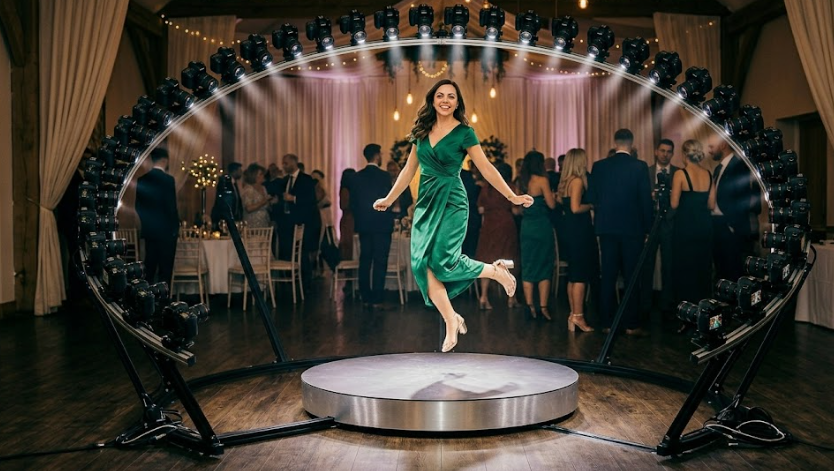
What is the best 3D photo booth? The leading options are bullet time camera arrays that freeze guests in mid-air while the view sweeps around them, 360 video booths that orbit guests in dramatic slow motion, and robotic camera arms that capture cinematic dimensional movement. Bullet time setups rent for 2,000 to 5,000 dollars, while 360 booths run 800 to 1,800 dollars, and both deliver the depth-defying footage flat photography simply cannot produce.
“3D” in the photo booth world does not mean red-and-blue glasses. It means capture that moves through space, footage where the camera’s perspective travels around frozen or slow-motion subjects, creating the dimensional, movie-grade effect audiences know from action films. Let’s break down the formats, what they cost, which events justify which tier, and how to book one without overpaying.
What Makes a Photo Booth “3D”
Traditional booths capture a moment from one fixed angle. 3D formats capture the space around the moment, and they do it through three distinct technologies worth understanding before you compare quotes.
Bullet time arrays use a curved rig of many cameras, often 12 to 50 of them, all firing simultaneously or in rapid sequence. Software stitches the frames into a clip where time freezes while the viewpoint sweeps around the subject, the effect cinema made famous in The Matrix. Because the subject is genuinely frozen at one instant seen from many angles, this is the truest “3D” experience in the category, and the most dramatic.
Orbiting platforms flip the architecture: one high-speed camera travels around stationary guests on a motorized arm. The result is the signature 360 clip, slow-motion footage circling guests as they dance, pose, or toss confetti. Time keeps moving, but the orbit creates the dimensional feel.
Robotic cinema arms put a high-speed camera on a programmable robot arm that executes precise sweeping moves past guests, producing the gliding, dimensional glamour shots seen on red carpets.
The shared appeal across all three: the output looks expensive. Dimensional footage reads as production-grade content rather than party snapshots, which is exactly why these formats dominate brand activations, galas, and celebrations chasing a centerpiece moment.
Comparing the 3D Booth Formats
Here is how the three technologies stack up where it counts.
| Format | How It Captures | Typical Rental | Space Needed | Signature Output |
| Bullet Time Array | 12-50 cameras fire at once around guests | $2,000 – $5,000 | 12×12 ft or more | Frozen-time sweep around mid-air poses |
| 360 Orbiting Booth | One camera orbits on a motorized arm | $800 – $1,800 | 10×10 ft | Slow-motion circling video |
| Robotic Cinema Arm | Programmed robot arm sweeps past guests | $1,500 – $3,500 | 10×12 ft | Gliding cinematic glamour clips |
Choose bullet time when the event needs a spectacle. Nothing in the booth world generates louder crowd reactions than a guest frozen mid-leap while the perspective whirls around them. The format’s spectator value is enormous, since the surrounding crowd watches every capture like a performance, and brands have made it the backbone of premium activations. The bullet time booth brings that full multi-camera array experience, and the playbook behind events like the ultimate fan experience for Super Bowl LIX shows why: frozen-time fan moments turn foot traffic into hours of engagement and a flood of branded shares.
Choose 360 when you want the proven crowd-pleaser. The 360 photo booth is the category’s value champion: dimensional footage at a third of bullet time’s price, a smaller footprint, faster guest cycling, and a format every guest already understands. For weddings and parties, it remains the default 3D pick, delivering 90 percent of the wow at a fraction of the logistics.
Choose the robotic arm when elegance outranks spectacle. A glambot photo booth produces the most refined footage of the three, sweeping, slow-motion glamour clips with red-carpet pedigree. It suits galas, luxury weddings, and fashion-forward events where the goal is making guests look extraordinary rather than making them jump.
For most hosts the decision tree is simple: budget under 2,000 dollars points to 360, a showstopper mandate points to bullet time, and a glamour mandate points to the arm. Events past 200 guests increasingly book two, one for spectacle, one for volume.

What Drives 3D Booth Pricing
3D formats cost more than standard booths, and the premium traces to real hardware and labor rather than hype.
Camera count and processing. A bullet time rig is literally dozens of cameras, each needing mounting, syncing, calibration, and post-capture stitching. The hardware investment behind a single professional array can exceed 30,000 dollars, and rental pricing amortizes it.
Skilled operation. These are not kiosks. Bullet time requires an operator calibrating the array and directing guests into the capture zone; 360 platforms need attendants managing safety and pacing; robotic arms need programmed move sequences tested before doors open. Staffing is typically two people for bullet time versus one for standard booths.
Setup time. Arrays take two to four hours to build and calibrate, which means vendors block longer venue windows and price accordingly. Confirm setup happens before your paid hours begin.
Output processing. Dimensional clips need stabilization, speed ramping, music, and branded overlays rendered fast enough for same-night sharing. That rendering infrastructure, covered well in the AI photo booth smart features guide alongside other delivery technology, is a real cost line, and vendors who skip it deliver footage days later, killing the social moment.
A fair-pricing anchor: expect roughly 600 to 900 dollars per hour for bullet time with two operators, 250 to 450 per hour for professional 360 packages, and 400 to 700 per hour for robotic arm experiences, all including setup, delivery, and customization.
Planning Logistics for a 3D Booth
Dimensional formats carry venue requirements that flat booths do not, and the smoothest events settle them early.
Footprint and clearance. Bullet time arrays need a 12 by 12 foot zone minimum plus operator space, and orbiting platforms need ten feet of ceiling clearance for the arm’s sweep. Measure before booking, not after.
Floor and power. Multi-camera rigs and motorized platforms want level floors and dedicated circuits, typically one to two 20-amp circuits depending on format. Historic venues and tents need this conversation earliest.
Safety management. Spinning arms and jumping guests demand trained attendants enforcing capacity limits and keeping drinks off platforms. This is also where insurance enters: reputable vendors carry liability coverage and provide certificates to venues on request, a requirement at most professional event spaces.
Placement for spectators. These formats entertain the crowd watching, so position them where a crowd can gather, adjacent to the bar or dance floor, never in a dead-end corner. The spectacle is half the rental’s value; placement determines whether anyone sees it.
Pairing for coverage. Spectacle formats cycle guests slowly, a bullet time capture takes a minute or more per group, so large events pair them with fast-volume coverage. Roaming options reach the guests who never queue, and the best robot photo booth rental guide shows why a floor-working robot photographer has become the standard partner to a stationed showpiece.

Rent or Buy: The 3D Booth Math
The buy-versus-rent question comes up constantly with 3D formats because the business opportunity is real. Here is the honest math.
| Factor | Renting | Buying |
| Upfront cost | $800 – $5,000 per event | $2,500 – $8,000 (360), $15,000 – $40,000+ (bullet time) |
| Ongoing costs | None | Software, insurance, vehicle, maintenance, storage |
| Operator | Included and trained | You, or staff you hire and train |
| Equipment currency | Vendor upgrades regularly | Yours ages on your books |
| Breakeven | Immediate value per event | 10-20 bookings for 360, far more for arrays |
| Right for | Hosts, planners, one-off events | Committed rental entrepreneurs |
For anyone hosting events, renting wins without contest. For aspiring operators, 360 platforms are the realistic entry point, since bullet time’s capital cost and two-person staffing model demand an established client base before the math closes. Either way, owners need commercial liability insurance from day one, both because venues require certificates and because motorized platforms surrounded by celebrating guests are exactly what liability policies exist for.
Things To Know
A few field realities will sharpen your 3D booking. First, the best 3d photo booth experiences are choreographed, so ask whether the vendor provides pose direction and prop guidance, because frozen-time footage of guests standing flat-footed wastes the entire format, while a directed mid-air toss or group leap produces the clip everyone shares. Second, music licensing shapes where clips can be posted, so confirm the vendor uses cleared tracks or accepts your playlist. Third, bullet time inventory is genuinely scarce in most markets, with far fewer arrays than 360 platforms in circulation, making 10 to 14 weeks of lead time the safe window for peak-season dates. Fourth, outdoor installations need wind and surface planning, since arrays on grass require leveling platforms and orbiting arms have wind limits, so flag outdoor venues in your first inquiry. Fifth, ask to see raw unedited output from a recent event, because stitching quality varies dramatically between operators and marketing reels hide it. And sixth, the formats reward a designated moment, with hosts who schedule the bridal party, executive team, or guest of honor through the rig early in the night anchoring the gallery before the crowd loosens up and the captures get wilder.

Choosing the Best 3D Photo Booth for Your Event
The best 3d photo booth depends on the moment you are building: bullet time when the event demands a frozen-in-air spectacle, a 360 platform when you want proven dimensional energy at the friendliest price, and a robotic cinema arm when glamour is the brief. Whichever direction you choose, confirm the operator, the clearance, the insurance certificate, and the same-night delivery, because those four details separate a centerpiece from a headache.
Mihi Entertainment operates the full dimensional lineup, bullet time arrays, 360 platforms, and cinematic robot arms, at weddings, galas, and brand activations across Colorado and nationwide. Pick your effect, clear the footprint, and give your guests the one party memory that moves in every direction.
FAQs About 3D Photo Booths
How much does a 3D photo booth cost?
3D photo booth rentals cost 800 to 1,800 dollars for 360 platforms, 1,500 to 3,500 dollars for robotic cinema arms, and 2,000 to 5,000 dollars for bullet time camera arrays, typically covering two to four hours. Pricing scales with camera count, staffing, customization, and market. For purchase, 360 platforms start around 2,500 dollars while professional bullet time rigs run 15,000 to 40,000 dollars or more, which is why arrays remain almost exclusively a rental product.
Are 360 photo booths worth buying?
360 booths are worth buying only as a business investment, since platforms cost 2,500 to 8,000 dollars plus lighting, software, insurance, and transport, while operators charging 800 to 1,800 dollars per event recoup costs within ten to fifteen bookings. For personal events, the math never favors ownership over a professional rental with an operator included. As a venture, demand remains strong, but success hinges on marketing and weekend booking volume, not the hardware itself.
Is it cheaper to rent or buy a photobooth?
Renting is cheaper for anyone hosting fewer than four or five events a year, while buying only pays off with steady commercial use. Quality booth hardware runs 3,000 to 10,000 dollars before recurring software, supplies, and insurance, and 3D formats multiply those figures. A rental delivers current equipment, trained staff, and instant delivery infrastructure for a fraction of ownership cost, which is why even many professional planners rent rather than own.
How much is a 360 photo booth?
360 photo booth rentals average 800 to 1,800 dollars for two to four hours, with most three-hour packages landing near 1,200 dollars, while purchasing a platform costs 2,500 to 8,000 dollars before accessories. Rental pricing varies with platform size, since larger four-person platforms cost more than single-guest units, plus staffing, branded overlays, and instant delivery features. Peak wedding season and December corporate weeks push quotes toward the top of the range.
Do you need insurance for a 360 photo booth?
Yes, anyone operating a 360 booth commercially needs general liability insurance, typically one million dollars in coverage, and most venues require a certificate of insurance before allowing setup. Motorized spinning arms around guests create genuine liability exposure, and policies for booth businesses run roughly 500 to 1,500 dollars annually. For hosts renting, the obligation sits with the vendor, so simply confirm your rental company is insured and can furnish your venue’s certificate on request.