 Skip to content
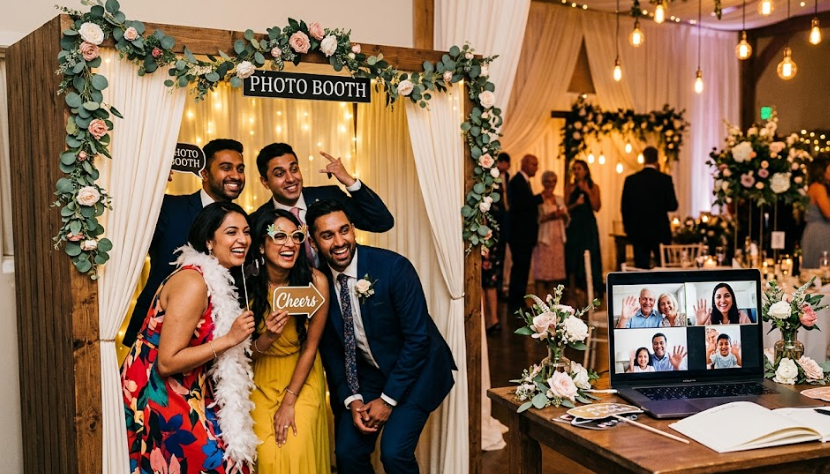
What is the best lovestream photo booth? It is a booth setup built for live sharing, combining instant digital delivery, real-time online galleries, and video message capture so that remote guests watching your wedding livestream can see, react to, and even participate in the booth fun as it happens. The strongest setups pair a 360 or glam booth for in-person energy with a video message station for the loved ones tuning in from afar, typically costing 1,200 to 3,000 dollars combined.
Livestreamed weddings went from emergency workaround to permanent fixture, and couples quickly discovered the gap in them: remote guests could watch the ceremony but missed the party. A live-sharing booth closes that gap. Let’s break down how these setups work, which formats fit best, and how to make grandma in another time zone feel like she was on the dance floor.
What Makes a Photo Booth Livestream-Ready
Any booth takes photos. A lovestream-ready booth moves them, instantly, to the people who could not be in the room. Four capabilities separate the real thing from an ordinary rental.
Instant delivery infrastructure. Photos and videos must hit guests’ phones and the online gallery within seconds, not the next morning. That requires booths with built-in connectivity and vendors who bring their own hotspots when venue Wi-Fi wobbles, which it always does at full occupancy.
A live online gallery. The heart of the lovestream experience is a gallery link that updates in real time. Remote guests keep it open beside the ceremony stream and watch the party document itself: the cousins’ group shot appears, then the grandparents’ portrait, then the bridal party chaos. It turns passive viewers into an audience with a feed.
Two-way participation. The best setups let remote guests send content in, not just watch. Virtual booth links allow far-away loved ones to snap selfies with the same branded overlay the in-person booth uses, dropping their faces into the same shared gallery. The couple wakes up to one album containing everyone, regardless of geography.
Video message capture. Streams flow one direction; messages flow back. A station where in-person guests record toasts, advice, and congratulations gives the couple, and remote viewers watching highlights later, the voices of the night, not just its faces.
When evaluating vendors, ask one cutting question: “Can my aunt in another country see booth photos while the reception is still happening?” Vendors equipped for live sharing answer with specifics. Everyone else offers you a next-day download link.
The Best Booth Formats for a Livestreamed Celebration
Some formats translate to a remote audience better than others. Here is how the leading options perform for hybrid events.
| Format | Live-Sharing Strength | Typical Rental Range | Remote Guest Experience |
| 360 Video Booth | Dynamic clips stream and share instantly | $800 – $1,800 | Watching clips land in real time |
| Video Message Station | Captures toasts and greetings for two-way connection | $900 – $2,000 | Receives heartfelt messages, can send some back |
| Glam Booth | Editorial portraits populate the live gallery | $1,200 – $2,500 | Sees polished portraits of everyone they know |
| AI Photo Booth | Themed transformations spark live reactions | $900 – $2,000 | Surprise and delight in the gallery feed |
| Slow Motion Booth | Cinematic moments built for replay | $900 – $2,200 | Shareable clips of key celebrations |
| Roaming Robot | Covers the whole floor, no one missed | $1,500 – $3,500 | Sees every table, not just booth visitors |
Two formats anchor most lovestream setups, and they solve opposite halves of the problem.
The 360 photo booth solves the energy problem. Its spinning slow-motion clips are the most watchable booth output ever invented, and when they land in a live gallery seconds after capture, remote guests get a rolling highlight reel of the party’s spirit. For viewers stuck watching a static ceremony camera, those clips are the difference between observing a wedding and feeling one.
The video testimonial booth solves the connection problem, and at hybrid weddings it quietly becomes the most meaningful rental of the night. In-person guests step in throughout the evening to record messages, the toast they were too shy to give, the story about the couple’s first apartment, the grandmother’s blessing in her first language. Compiled and shared, those recordings reach remote guests with an intimacy no livestream camera achieves, and the couple keeps a time capsule that outlives every other deliverable.
For couples wanting the full picture, adding a glambot photo booth brings the red-carpet cinematic arm famous from celebrity events, producing sweeping glamour clips that make the live gallery look like awards-show coverage, a detail remote guests genuinely talk about.

Designing the Hybrid Experience End to End
Hardware is half the lovestream equation. The other half is choreography, making the in-person and remote experiences reinforce each other rather than run in parallel.
Send the gallery link with the stream link. Remote guests should receive one message containing both: watch here, follow the party here. Couples who send the gallery link separately or late find remote guests never discover it.
Schedule shared moments. Pick two or three points in the night, after the first dance, before cake cutting, where the DJ or coordinator directs in-person guests to wave into the booth for the folks watching from home. Those thirty-second rituals do more for remote-guest belonging than three hours of passive streaming.
Give remote guests a job. Virtual booth participation works best with a prompt: “Send us your toast from your living room” or “Show us how you dressed up to watch.” Specific asks produce participation; open invitations produce silence.
Route messages back into the room. The strongest hybrid moment runs in reverse: remote guests’ photos and recorded messages displayed on a screen at the reception. Suddenly the couple’s college roommate overseas is part of the decor, and in-person guests crowd the screen looking for faces they miss.
Plan the next-morning package. The lovestream gallery becomes the couple’s first married-life artifact. Confirm the vendor delivers full-resolution files, compiled video messages, and analytics on the gallery, which doubles as a digital guest book showing exactly who celebrated from where. Modern platforms handle all of this elegantly, and the AI photo booth smart features guide covers the delivery and gallery technology that makes the live experience effortless.
Destination weddings benefit most of all. When the venue is a flight away for half the guest list, the lovestream setup is not an accessory but the second venue, and stunning remote settings, like the coastal ballrooms in the Belle Mer Newport Rhode Island guide, give the live gallery a backdrop remote guests genuinely enjoy watching.
Budgeting a Lovestream Booth Setup
Hybrid setups layer components, so budgets work best built from a base format upward.
| Setup Tier | Components | Typical Combined Cost | Best For |
| Essential | One booth with instant sharing and live gallery | $900 – $1,500 | Small hybrid weddings |
| Standard | Motion booth plus video message station | $1,800 – $3,000 | Most livestreamed weddings |
| Premium | Glam or 360 booth, message station, virtual booth access | $2,800 – $4,500 | Large hybrid celebrations |
| Showcase | Multiple formats, reception display screen, full compilation edit | $4,500 – $7,000+ | Destination weddings, galas |
The standard tier is the sweet spot for most couples: one format generating live energy for the gallery, one capturing messages flowing both directions. Within a typical wedding budget, that lands at 10 to 15 percent of total spend, normal entertainment territory, while doing double duty as the remote-guest experience, a line item that would otherwise cost separately.
Corporate and brand events have adopted the same architecture for hybrid audiences, streaming activations to attendees who could not travel, and the ultimate fan experience for Super Bowl LIX playbook shows the principle at full scale: live capture plus instant distribution turns one room’s experience into everyone’s.

Things To Know
A few realities specific to live-sharing setups deserve your attention before booking. First, connectivity is the single point of failure, so confirm your vendor brings dedicated hotspots rather than relying on venue Wi-Fi, and ask what happens to the live gallery if signal drops, since quality systems queue and sync rather than lose content. Second, time zones shape the schedule more than couples expect, because a 7 p.m. reception is 4 a.m. somewhere, so consider scheduling the key shared moments early in the evening when overseas relatives can realistically attend. Third, privacy settings matter on live galleries, and you control whether the link is open, password-protected, or guest-list restricted, a decision worth making deliberately when children or privacy-conscious guests attend. Fourth, the virtual booth link should go out twice, once before the wedding with instructions and once during cocktail hour as a reminder, because remote participation doubles with the second send. Fifth, compiled video messages take editing time, so expect the polished compilation a week or two after the wedding even though raw clips arrive immediately. And sixth, assign one tech-comfortable friend as the remote-guest shepherd, a single person monitoring the stream chat and gallery during the event, because hosts and couples will not have a free hand, and one designated helper prevents every hybrid hiccup from reaching the head table.

Choosing the Best Lovestream Photo Booth for Your Big Day
The best lovestream photo booth is really a system: a high-energy format feeding a live gallery, a video message station carrying voices both directions, and delivery infrastructure that makes distance irrelevant for one night. Build it around the people who cannot be in the room, schedule a few shared moments, and the livestream stops being a consolation prize and becomes a second seat at the celebration.
Mihi Entertainment builds live-sharing booth experiences for weddings and events across Colorado and nationwide, from 360 platforms with instant galleries to heartfelt video message stations your faraway guests will treasure. Wherever your loved ones are watching from, give them more than a stream. Give them the party.
FAQs About Lovestream Photo Booths
What photobooth do the Kardashians use?
The Kardashians use the Glambot, a robotic cinematic camera arm that captures ultra-slow-motion glamour clips, the same system seen at the Met Gala and Hollywood afterparties. That technology is now available for private events through professional rental companies, and it suits livestreamed celebrations especially well, since its dramatic clips give remote viewers red-carpet-quality footage of the people they love. It remains the single most-requested celebrity booth experience for weddings and galas.
What is the best photo booth to purchase?
For buyers, the best photo booths are professional open air systems with DSLR cameras, studio lighting, and established software, typically costing 4,000 to 12,000 dollars for business-grade equipment. Purchase only makes sense for venues, planners, or entrepreneurs running regular events, since software subscriptions, printers, insurance, and maintenance add ongoing cost. For a single wedding or party, even a livestreamed one, renting delivers newer technology, live-sharing infrastructure, and a trained attendant for a fraction of ownership cost.
What is the average cost of a photo booth for a wedding?
The average wedding photo booth rental costs 800 to 1,500 dollars for three to four hours, with premium formats like glam, 360, and AI booths running 1,200 to 2,500 dollars. Livestream-ready setups that add live galleries and video message capture typically land between 1,800 and 3,000 dollars combined. Most couples allocate 10 to 15 percent of their total budget to entertainment, and at hybrid weddings the booth earns extra value by doubling as the remote-guest experience.
Are 360 photo booths worth buying?
360 booths are worth buying only for commercial use, since quality platforms cost 2,500 to 8,000 dollars plus lighting, software, and a vehicle to haul them, while owners charging 800 to 1,800 dollars per event can recoup costs within ten to fifteen bookings. For personal use, the math never closes, because a one-time celebration is served far better by a professional rental with an operator. As a business, the format remains in strong demand, though success depends on marketing and steady weekend bookings rather than the hardware itself.
Which is better GoPro or Insta360?
For 360-degree content, Insta360 cameras are generally better, offering true 360 capture and stronger stitching software, while GoPro wins for traditional rugged action footage. Worth knowing: professional 360 photo booths use neither, relying instead on a standard high-frame-rate camera spinning on a motorized arm around stationary guests, which is what produces the signature orbiting slow-motion effect. Consumer 360 cameras capture everything around a point; booth rigs orbit the point, and the two produce completely different results.