 Skip to content
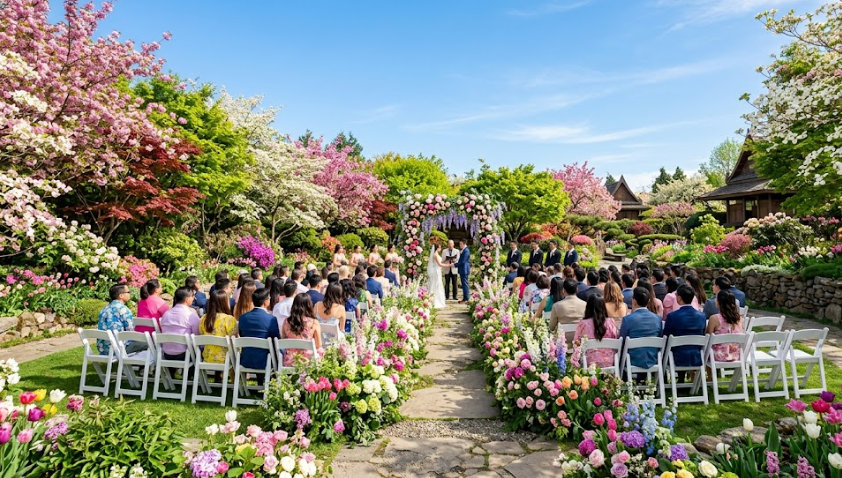
When is wedding season? In the United States, wedding season runs from May through October, with the absolute peak landing in June, September, and October. Roughly 70 to 80 percent of all weddings happen inside that six-month window, which means venue prices, vendor availability, and guest travel costs all rise and fall with the calendar.
Knowing where your date falls inside or outside that window changes almost everything about your planning, from how far in advance you need to book to how much negotiating power you have. Let’s walk through the full wedding calendar, why certain months dominate, and how smart couples use the off-season to stretch their budgets without sacrificing the celebration.
Why Wedding Season Exists in the First Place
Wedding season is not a marketing invention. It is the predictable result of weather, daylight, and tradition stacking on top of each other.
Weather drives everything. Most couples want some outdoor element, whether that is a garden ceremony, a patio cocktail hour, or golden-hour portraits. In most of the country, the reliable window for comfortable outdoor weather opens in late spring and closes in mid fall. Couples cluster their dates inside it, and the industry prices accordingly.
Daylight matters more than people realize. A June wedding gives photographers usable light until nearly 9 p.m. in many regions. A December wedding loses the sun before 5 p.m., which compresses the timeline and pushes portraits earlier into the day. Long evenings make peak-season receptions feel more leisurely.
Tradition and logistics reinforce it. June has been a culturally favored wedding month for generations, school calendars free up families for summer travel, and September and October deliver the most stable weather of the year in most states. Guests can plan vacations around summer dates, and fall foliage gives photographers a backdrop no decor budget can replicate.
The result is a calendar with sharp peaks and deep valleys, and the difference between them is measured in thousands of dollars.
The Wedding Calendar, Month by Month
Here is how the twelve months actually stack up for demand, pricing, and conditions. Demand levels reflect national patterns, so adjust for your region, since Arizona peaks in spring and fall while Colorado mountain venues peak in summer.
| Month | Demand Level | Typical Pricing | What to Expect |
| January | Very Low | Lowest of the year | Deep discounts, post-holiday lull, winter weather risk |
| February | Low | Low, except Valentine’s | Romantic framing, short days, cold in most regions |
| March | Low to Moderate | Below average | Early spring gamble, unpredictable weather |
| April | Moderate | Average | Spring blooms arrive, weather steadies in the South |
| May | High | Above average | Season opener, gardens at their best |
| June | Peak | Premium | Most popular month historically, longest daylight |
| July | High | Above average | Hot in many regions, holiday weekend conflicts |
| August | Moderate to High | Slightly above average | Heat and vacations thin demand slightly |
| September | Peak | Premium | Stable weather, warm evenings, top choice for modern couples |
| October | Peak | Premium | Fall color, cool comfort, now rivals June for bookings |
| November | Low to Moderate | Below average | Pre-holiday window, Thanksgiving conflicts |
| December | Low | Low, except NYE | Festive decor included at many venues, busy guest calendars |
Two shifts in this table are worth highlighting. First, fall has overtaken early summer in many markets, and September and October now claim more weddings than June in several recent industry counts. Second, the valleys are getting more attractive, because venues increasingly offer aggressive winter packages, and couples chasing value have noticed.

Peak Season vs. Off-Season: Which Is Right for You?
Choosing your season is really a tradeoff between conditions and cost, and the right answer depends on what you value most.
Choose peak season if outdoor elements are non-negotiable, your guest list includes teachers, students, or families tied to school calendars, or your vision depends on a specific natural backdrop like June gardens or October foliage. You will pay more and book earlier, often 14 to 18 months out for popular venues, but you buy the highest odds of perfect weather and the fullest vendor rosters.
Choose off-season if budget flexibility matters more than guaranteed sunshine. The identical venue, menu, and vendor team can cost 20 to 40 percent less in January than in September. Off-season couples also get their pick of in-demand vendors who are fully booked all summer, and they often receive more attention, since their wedding may be the only one their planner is running that week.
The shoulder months are the sweet spot for many couples. April, early May, and November offer near-peak conditions at below-peak prices. An April garden wedding in much of the South or a crisp early-November date in the Southwest captures most of the peak-season magic with meaningful savings.
One factor that should not change with the season is the guest experience inside the reception. Weather affects the ceremony, but the party is climate-controlled, and that is where entertainment carries the night. A winter reception with a graffiti wall photo booth glowing in the corner feels every bit as electric as a June one, which is exactly why off-season couples often redirect a slice of their venue savings into experiences guests will remember.
How Season Affects Every Vendor You Book
Your date does not just change the venue bill. It ripples through the entire vendor ecosystem.
Photographers and videographers charge premium rates for peak Saturdays and often discount winter weekdays by 15 to 30 percent. Off-season also means more available shooting talent, since the best photographers in any market sell out their summer Saturdays a year or more in advance.
Caterers and florists face seasonal cost swings of their own. Florists pay more for out-of-season blooms, so a peony-heavy design costs far more in October than in May. Caterers, by contrast, often sharpen their pricing in slow months to keep kitchens busy.
Entertainment vendors follow the same curve, and booking early matters most in the peak window. Interactive experiences have become the centerpiece of modern receptions, and the most in-demand setups disappear from calendars fast between May and October. If your heart is set on a cinematic moment like a bullet time booth freezing your guests mid-celebration, a peak-season date means reserving it six to twelve months ahead, while an off-season date often allows shorter lead times and package flexibility. Reading through ideas like the best custom trading card photo booth guide shows how couples are theming entertainment to their date, with trading-card keepsakes styled around fall colors or winter motifs.
Hotels and travel hit your guests’ wallets too. Summer wedding dates collide with vacation pricing, and room blocks in resort towns can cost guests double what they would pay in November. A thoughtful off-season date is, quietly, a gift to everyone traveling.

Planning Timelines by Season
When is wedding season for booking purposes? Earlier than most couples expect. Here is a realistic lead-time guide based on how quickly each season’s inventory disappears.
| Your Target Season | Venue Booking Lead Time | Vendor Booking Lead Time | Negotiating Power |
| Peak (June, Sept, Oct Saturdays) | 14-18 months | 10-14 months | Low |
| High (May, July, August) | 12-15 months | 9-12 months | Moderate |
| Shoulder (April, November) | 9-12 months | 6-10 months | Good |
| Off-Season (Dec-March) | 6-10 months | 4-8 months | Strongest |
| Any Friday or Sunday | Subtract 2-4 months | Subtract 2-3 months | Better than Saturday |
The day of the week deserves its own mention. A Friday or Sunday wedding in peak season often costs what a Saturday costs in the shoulder months, which makes it a clever middle path. Guests have adapted, and Friday weddings have grown steadily as couples chase both the season they want and a price they can live with.
Things To Know
A few seasonal realities deserve a place in your planning notes. First, peak season pricing applies to Saturdays above all, so shifting the same October weekend to a Friday can recover 10 to 25 percent of the venue cost instantly. Second, holiday weekends look tempting but cut both ways, because guests get a built-in travel day yet face inflated airfare and hotel rates, and some will quietly resent surrendering the long weekend. Third, hurricane season runs June through November in coastal regions, so waterfront couples should read venue postponement clauses carefully, something worth keeping in mind when browsing stunning coastal spaces like those in the Belle Mer Newport Rhode Island guide. Fourth, vendor minimums often drop in the off-season, meaning the catering spend or hour requirements that apply to a June Saturday may be negotiable in February. Fifth, daylight saving time ends in early November, so late-fall couples should schedule portraits with sunset sometimes arriving before 5 p.m. And sixth, your engagement length matters more than perfection, because chasing an ideal date eighteen months away is not automatically better than embracing a great shoulder-season date nine months out, and many couples report that shorter timelines kept decisions refreshingly simple.

When Is Wedding Season Working in Your Favor?
So, when is wedding season? May through October on paper, but the real answer is whenever the calendar aligns with your priorities. Peak-season couples buy ideal weather and pay for the privilege. Off-season couples trade some daylight for serious savings and first pick of the best vendors. Shoulder-season couples split the difference, and increasingly, they are the smartest planners in the room.
Whatever date you circle, the celebration inside the room is what guests carry home. Mihi Entertainment delivers unforgettable interactive experiences across Colorado and nationwide, every month of the year, from June garden receptions to candlelit January ballrooms. Pick your season, lock your date, and let the entertainment make it unmistakably yours.
FAQs About Wedding Season Timing
What months are wedding season?
Wedding season runs May through October, with June, September, and October as the three busiest months nationwide. Regional patterns shift the window, since desert markets like Phoenix peak in spring and fall while mountain and northern markets concentrate in summer. The off-season runs roughly December through March, when demand and pricing both hit their annual lows. If you hear a vendor mention “the season,” they almost always mean that May-to-October stretch.
Is $5000 enough for a wedding?
Yes, 5,000 dollars can cover a meaningful wedding if you keep the guest list under about 50 and choose an off-peak date. A January or February wedding stretches that budget dramatically, since venues, photographers, and caterers all discount their slow months. Couples at this level typically choose restaurant buyouts, community spaces, or backyard ceremonies, then concentrate the budget on one or two memorable elements rather than spreading it thin across everything.
What is the cheapest month to marry?
January is generally the cheapest month to get married, followed closely by February and March. Demand bottoms out after the holidays, and venues offer their deepest discounts to fill empty calendars, often 20 to 40 percent below peak rates. December can also be surprisingly affordable outside of New Year’s Eve, with the bonus that many venues are already decorated for the holidays, which trims your decor budget further.
What is the 50 30 20 rule for weddings?
The 50 30 20 rule assigns 50 percent of your budget to venue and catering, 30 percent to core services like photography, attire, and coordination, and 20 percent to extras plus a contingency buffer. It works in any season, but the math gets friendlier off-peak, because when the venue share shrinks in a January booking, that savings flows directly into the 30 and 20 percent categories. Many off-season couples use the difference to upgrade entertainment or photography coverage.
Is $70,000 enough for a wedding?
Yes, 70,000 dollars is well above the national average wedding cost and funds a premium celebration in most markets, even at peak season. That budget comfortably covers a sought-after venue on a September or October Saturday, full-service planning, top-tier photography, and standout entertainment for 100 to 150 guests. In the most expensive metro areas like New York or San Francisco, it still delivers a beautiful wedding, though couples there may make a few strategic trims or consider a Friday date to unlock more.