 Skip to content
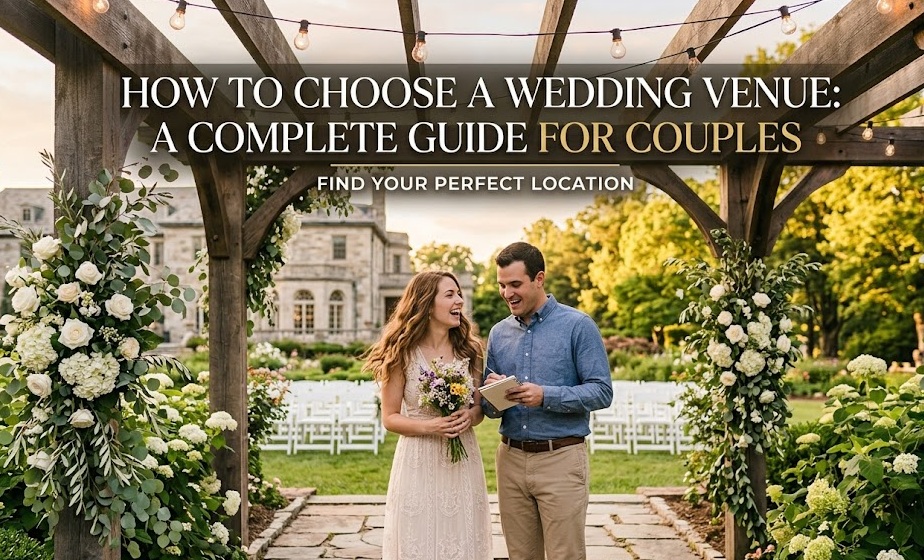
Wondering how to choose a wedding venue? Start by locking in three numbers before you tour anything: your total budget, your estimated guest count, and your preferred date range. Once those are set, you can filter venues by capacity, cost, and availability, then judge the finalists on style, logistics, and the experience they offer your guests.
The venue decision shapes nearly every other choice you make, from catering and decor to entertainment and photography. It typically eats up 30 to 40 percent of your total wedding budget, which is exactly why it deserves a deliberate, step-by-step approach instead of a weekend of impulsive Pinterest scrolling.

Things To Know
There are a handful of realities about venue hunting that couples rarely hear until they are deep in the process.
First, the advertised rental fee is almost never the real price, because service charges of 20 to 25 percent and taxes are routinely added to food and beverage totals, so always request a sample invoice for a wedding of your size.
Second, off-peak booking is the single biggest lever for savings, since the identical venue on a Friday in November can cost 40 percent less than a Saturday in June.
Third, read the cancellation and postponement clauses before signing, because deposits are typically non-refundable and the rebooking terms vary wildly between contracts.
Fourth, ask who your day-of contact will be, since the charming salesperson who gives the tour is often not the person running your actual wedding.
Fifth, confirm vendor insurance requirements early, because many venues require outside vendors to carry liability coverage and provide certificates weeks in advance.
And sixth, trust the gut reaction you had in the first five minutes of the tour, because couples overwhelmingly report that their final choice was the space that simply felt right the moment they walked in.
Why the Venue Decision Comes First
Most planners agree that the venue is the first major booking a couple should make, and there are practical reasons behind that advice. Your venue determines your date. Popular spaces in Colorado and across the country book 12 to 18 months out, and Saturday dates in peak season often disappear two years in advance. Until you have a venue, you cannot send save-the-dates, book a caterer, or hire a band.
The venue also sets your guest ceiling. A room that comfortably holds 120 people cannot stretch to 180 no matter how much you love it, so your guest list and your venue have to be decided in tandem. And finally, the venue establishes your aesthetic. A mountain ranch, a downtown art museum, and a historic mansion each push your decor, attire, and entertainment in completely different directions. Choosing the space first means everything else gets easier, not harder.
There is one more reason couples often overlook: vendor logistics. Some venues have exclusive catering contracts, preferred vendor lists, or strict rules about outside entertainment. If you have your heart set on a specific experience, like a 360 photo booth spinning at the center of your reception, you need to confirm the venue allows outside entertainment vendors, has the floor space, and offers adequate power before you sign anything.
The Three Numbers That Narrow Your Search
Before you schedule a single tour, sit down with your partner and anyone contributing financially, and settle these three figures.
Your total budget. Not your venue budget, your entire wedding budget. The venue and catering combined typically consume the largest share, so knowing your full number lets you work backward. If your total budget is 40,000 dollars, a 25,000 dollar venue fee leaves dangerously little for everything else.
Your guest count. Even a rough range works. The difference between 75 guests and 150 guests eliminates half the venues in any market instantly. Count realistically, including plus-ones and children, and remember that roughly 10 to 20 percent of invitees typically decline.
Your date flexibility. Couples with a fixed date have far fewer options than couples with a flexible season. If you can move from a June Saturday to a June Friday or an October Saturday, your venue pool roughly doubles and your pricing often drops 15 to 30 percent.

How to Evaluate Venue Types
Once your numbers are set, the next step is deciding which category of venue fits your vision. Each type carries its own cost structure, level of effort, and atmosphere. Here is how the most common options compare.
| Venue Type | Typical Cost Level | What’s Usually Included | Best For |
| Hotel or Resort | High | Catering, tables, linens, coordinator, lodging | Couples who want convenience and out-of-town guests |
| Banquet Hall | Moderate | Tables, chairs, in-house catering, basic decor | Larger guest lists on a controlled budget |
| Barn or Ranch | Moderate to High | Space only, sometimes tables and chairs | Rustic style, outdoor ceremonies, full customization |
| Museum or Gallery | High | Space and built-in ambiance, vendor list required | Couples wanting a striking, decor-light backdrop |
| Restaurant or Brewery | Low to Moderate | Food, beverage, furniture, staff | Intimate weddings under 100 guests |
| Backyard or Private Estate | Variable | Nothing, everything is rented | Total creative control and sentimental settings |
The biggest trap in this stage is comparing venues by rental fee alone. A 4,000 dollar barn that requires you to rent tables, chairs, linens, restrooms, lighting, and a catering tent can easily cost more than a 12,000 dollar hotel package that includes all of it. Always build an apples-to-apples total before judging a price.
All-inclusive venues suit couples who want to make fewer decisions and value predictability. Blank-slate venues suit couples with a strong creative vision and the patience to coordinate eight or more separate vendors. Neither is objectively better. The right choice depends entirely on how much time, energy, and decision-making appetite you actually have.
The Walkthrough: What to Look for on a Tour
Photos lie. Every venue looks spectacular in its marketing gallery, which is why touring in person, ideally at the same time of day as your planned event, is non-negotiable. When you walk a space, work through these areas methodically.
Flow and layout. Trace your guests’ actual path. Where do they arrive, where is the ceremony, where do they wait during cocktail hour, where do they eat, and where do they dance? Awkward transitions, long walks between spaces, or a dance floor crammed into a corner will shape the entire energy of your night.
Capacity in practice. A venue’s stated capacity often assumes standing room. Ask what the capacity is with a full seated dinner, a dance floor, a band or DJ setup, and entertainment stations. A room rated for 200 may realistically hold 140 once everything is in place. This matters enormously if you are planning interactive entertainment. A glambot photo booth with its cinematic camera arm, for example, needs a dedicated footprint and clearance that a packed floor plan cannot offer.
Lighting and power. Visit at your event’s actual hour. A room flooded with gorgeous afternoon light may feel like a cave at 8 p.m. Ask about dimmers, uplighting options, and the number and location of power circuits, since DJs, caterers, and entertainment vendors all draw significant power.
Weather contingency. For any outdoor ceremony or reception, demand to see the rain plan in person, not in a brochure. If the backup space is an unappealing basement, you are gambling your wedding on the forecast.
Restrictions and curfews. Noise ordinances, hard end times, open flame bans, confetti rules, and vendor load-in windows all live in the fine print. A 9:30 p.m. music curfew can quietly ruin the party you imagined.

Comparing Your Finalists Side by Side
By the time you have toured four or five spaces, the details start to blur together. A simple scoring exercise keeps your decision grounded. Rate each finalist from 1 to 5 in every category, then total the columns.
| Decision Factor | Why It Matters | Questions to Ask |
| Total True Cost | Rental fee plus all required rentals and minimums | What is included, and what are food and beverage minimums? |
| Guest Experience | Comfort drives the memories guests keep | Is parking easy? Are restrooms adequate? Is it accessible? |
| Date Availability | Your ideal season and day of week | What dates are open, and is there off-peak pricing? |
| Style Fit | Less decor spend when the bones are beautiful | Does the space match our vision without heavy transformation? |
| Vendor Flexibility | Freedom to hire the team you want | Can we bring outside catering and entertainment? |
| Logistics | The unglamorous details that make or break the day | What are load-in times, curfews, and staffing arrangements? |
When two venues score nearly the same, the tiebreaker should almost always be the people. The venue coordinator you click with, who answers emails within a day and solves problems instead of citing policies, is worth thousands of dollars of stress relief. Couples consistently report that responsiveness during the inquiry stage predicts responsiveness during the planning crunch.
This is also the stage where you should think about how the space supports entertainment. Modern receptions increasingly center on interactive experiences rather than passive ones, and the venue needs to accommodate that. Reading up on options like the AI photo booth smart features available for modern events can help you ask the right spatial and power questions before you commit to a floor plan.

Matching the Venue to Your Entertainment Vision
A venue is a container, but entertainment is what fills it with energy, and the smartest couples evaluate both together. If your dream reception includes a live illustrator-style experience, you will want to confirm space for something like a sketchbot booth where guests receive AI-drawn portraits as keepsakes. If you are drawn to grand, architecturally stunning spaces, it helps to study how other couples have activated them. Venue features like those covered in the Belle Mer Newport Rhode Island guide show how waterfront ballrooms pair with high-impact entertainment, while the Wrigley Mansion Phoenix breakdown demonstrates how historic estates handle modern photo experiences without disrupting their character.
Thinking through how to choose a wedding venue with entertainment in mind from day one prevents the most common post-booking regret: falling in love with an experience your space cannot physically support. Ask every finalist about floor load, ceiling height, dedicated circuits, and Wi-Fi strength. These five-minute questions save heartbreak later.
How to Choose a Wedding Venue with Confidence
Learning how to choose a wedding venue really comes down to sequencing: numbers first, categories second, tours third, and a side-by-side comparison last. Couples who follow that order consistently spend less, stress less, and end up in spaces that genuinely fit their celebration rather than spaces they talked themselves into.
Once your venue is locked, the fun begins. Mihi Entertainment partners with venues across Colorado and nationwide to bring interactive experiences that turn a beautiful room into an unforgettable night. Whatever space you choose, make sure the memories made inside it are ones your guests will be talking about for years.
FAQs About Choosing a Wedding Venue
What is the 30-5 rule for weddings?
The 30-5 rule suggests allocating roughly 30 percent of your budget to the venue and finalizing your top 5 priorities before booking anything. In practice, couples use it as a guardrail: if a venue demands much more than a third of your total budget, something else, usually food, photography, or entertainment, will get squeezed. Listing your five non-negotiables first keeps emotional tours from derailing your finances.
How to pick the perfect wedding venue?
Set your budget, guest count, and date range first, then tour only the venues that fit all three and score them on cost, style, logistics, and guest experience. Perfection is less about finding a flawless space and more about finding the one whose tradeoffs you can happily live with. Tour at your event’s actual time of day, ask for a full sample invoice, and pay close attention to how responsive the coordinator is, since that relationship carries you through the entire planning process.
What is the 50 30 20 rule for weddings?
The 50 30 20 rule allocates 50 percent of your budget to venue and catering, 30 percent to essential services like photography and attire, and 20 percent to extras and a buffer. Borrowed from personal finance, it works well as a starting framework. The 20 percent cushion is the part most couples skip and most regret skipping, because overages on flowers, alterations, and last-minute rentals are nearly universal.
What do you need to consider when choosing a venue?
Consider total true cost, capacity, availability, style fit, vendor flexibility, logistics, and your weather backup plan. Beyond those core seven, dig into the fine print: service charges, curfews, insurance requirements, and who your actual day-of contact will be. The venues that feel effortless on the wedding day are almost always the ones whose contracts were read carefully months earlier.
What are the 5 factors that you have to consider when choosing a location?
The five core factors are budget, capacity, accessibility, ambiance, and logistics. Budget sets your ceiling, capacity must match your guest list with room for dining and dancing, accessibility covers parking, travel distance, and mobility needs, ambiance determines how much decor you will need to buy, and logistics covers power, load-in, curfews, and vendor rules. A venue that scores well on all five rarely produces regrets.